


A common challenge in explaining economic policies to the public is their ability to interpret the data effectively. Labor market policies are no different in this regard. Understanding labor market data, such as unemployment, underemployment, labor force participation rate, jobs gap, NEET (Not in Education, Employment, or Training) population, and unpaid work, is essential due to their conceptual complexity and statistical importance.
The unemployment rate does not accurately measure labor market performance in developing or least-developed countries. In economies dominated by informal employment, many types of work are considered employment, and it is not very difficult to find work for at least an hour a week.
A person in employment, as defined by the International Labour Office (ILO), is a person aged 15 or over who has done at least one hour’s paid work in a given week or who is absent from work for certain reasons (annual leave, sickness, maternity, etc.) and a certain period.
Policymakers and citizens should recognize that underemployment, the NEET population, an inactive workforce, and own-account workers are better indicators of labor market performance in developing countries. However, politicians often highlight unemployment to showcase their regimes’ successes.
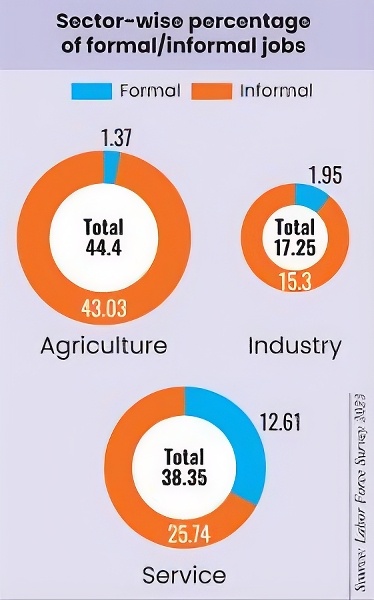
What do we mean by underemployed or underutilized workers? ILO defines time-related underemployment as employed individuals who, during a short reference period, wanted to work additional hours, worked less than a specified hours threshold, and were available to work additional hours.
For instance, in 2023, Bangladesh had an estimated 2.59 million unemployed individuals, with the unemployment rate at 3.51%. Additionally, 6.26 million working-age people were underutilized. The underutilized or underemployed population is almost double the unemployed population.
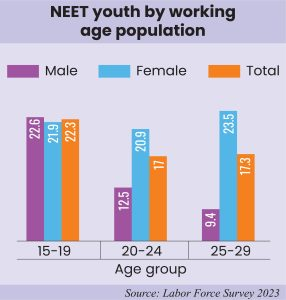
What does NEET signify in the labor market? A ‘high NEET rate’ means many young people (15-29) are not in employment, education, or training. This signifies disengagement from the labor market and society, highlighting youth vulnerability and economic inactivity.
What does NEET signify in the labor market? A ‘high NEET rate’ means many young people (15-29) are not in employment, education, or training. This signifies disengagement from the labor market and society, highlighting youth vulnerability and economic inactivity.
If anyone observes Bangladesh’s NEET youth, they are around 30%, largely influenced by females. According to ILOSTAT, the labor force participation rate stands at 49.5%. Alarmingly, the NEET rate has reached 30.9%.
“Out of the labor force” is another strong indicator of a country’s labor market performance, which is more important in a developing country. It is a residual category that includes people who do not comply with the requirements for being considered employed or all of those required to be considered unemployed.
It includes persons who do not want a job, discouraged workers, and persons who are not currently available to work and are searching for a job but took their last active step a long time ago.
Historically, in Bangladesh, about 40% to 50% of the working-age population remains under this category, meaning that half of the country’s working-age population is basically inactive and doing nothing. The biggest risk of being inactive for a long time is withdrawal from economic activity, which results in ‘discouraged workers’.
Discouraged workers are persons who are without work and available for work but did not actively seek work because they felt that no work would be available to them. Therefore, they could not be classified as unemployed.
Several pieces of labor market literature provide empirical evidence that youth who remain in NEET and remain inactive in the economy gradually become discouraged workers. Their lack of motivation to be active in the economy increases their chances of getting involved in crimes and anti-social activities.
This Op-Ed was published on Industry Insider on May 09, 2025